Showing posts with label solitaire. Show all posts

Saturday, July 10, 2010

Anna (Double Deck Solitaire Game)


Rules

  1. Families are built upon the foundations in suit and descending sequence from knave down to ace and ending with king.
  2. Marriages are made in suit and ascending sequence between exposed auxiliary cards, and upon the auxiliary cards from the pack as dealt.
  3. If a queen appears in the original eight auxiliary cards, or in a vacancy, she cannot be removed for marriage, but must remain in her place. Marriages may be made upon such queen in the same manner as upon other auxiliary cards.
  4. Cards as dealt, exposed auxiliary cards, and exposed cards of the talon, are available.

Play

Deal eight cards from the pack, arranged in the form of an A. These are the auxiliary cards.

If a knave appears, remove it and place it in such position that, with the other seven knaves as they are dealt, they will form a letter N. These knaves are the foundations to be built upon according to Rule 1.

Fill vacancies always from the pack.

Marry auxiliary cards as in Rule 2, but strictly observing Rule 3.

Deal from the pack, one by one, playing suitable cards as they appear according to Rules 1 and 2. Unsuitable cards form a talon.

Two re-deals are allowed.

If the game succeeds, the letter A will be all queens, and the foundations all kings.

(From Dick's games of patience: or, Solitaire with cards, ed. Harris B. Dick [1898].)

The Reversal (Double Deck Solitaire Game)


Rules

  1. Families are formed in suit upon the deuce-foundations in ascending sequence, ending with ace; upon ace-foundations in descending sequence through king, queen, etc., down to deuce.
  2. Cards as dealt, all cards dropped to the right, and the exposed cards of the auxiliary packets, are available.

Play

Deal four cards in a row, and drop the next two dealt cards to the right; deal four more cards upon the first four, and again drop two to the right, as seen in the Tableau. These four packets are the auxiliary cards.

As the four aces and deuces of different suits appear, place the aces in a row below, and the deuces in a row above, the auxiliary row. These aces and deuces are the foundations for families according to Rule 1.

When all the suitable cards have been played upon the foundations, deal four more cards upon the auxiliaries, dropping two more cards to the right, and repeat the same routine until the pack is exhausted; then, if necessary, the dropped cards and the auxiliaries may be gathered together, and two fresh deals allowed; a fourth deal is also permissible, but without any dropped cards.

If the Patience is successful, the ace row and the deuce row will have changed places.

(From Dick's games of patience: or, Solitaire with cards, ed. Harris B. Dick [1898].)

The Japanese Rug (Double Deck Solitaire Game)


Rules

  1. Families are built upon the foundation aces in suit and ascending sequence up to king, and upon the foundation kings in suit and descending sequence down to ace.
  2. Any card, on either of the four sides of the rug, whose narrow end is exposed, is available, and when an available card is removed it releases any other card whose narrow end it had previously obstructed.

Play

Take from the pack the four aces and kings of different suits, and arrange them in a row, the aces to the left, the kings to the right. These are the foundation cards to be built upon according to Rule 1.

Deal sixty-four cards from the pack in eight rows of eight cards each, alternately upright and longways, both in the rows and columns, as displayed in the Tableau.
According to Rule II, at the start the cards marked with a * are available, and any of them that are suitable are played upon the foundations.

Then deal the remainder of the pack, one by one, playing suitable cards as they appear, and unsuitable cards upon the talon. Watch each card as it is placed upon the talon, because available cards from the rug may be married upon it in suit and in ascending or descending sequence, thus possibly releasing suitable cards in the rug for the foundations; such marriages should be done in any case when possible, to reduce the rug.

Two re-deals are permitted.

(From Dick's games of patience: or, Solitaire with cards, ed. Harris B. Dick [1898].)

Monday, June 28, 2010

Canfield or Klondike (Single Deck Solitaire Game)


One Entire Pack Of Cards.

From "The Official Rules of Card Games," copyright 1897, 1898, 1899, 1900, 1904, 1907, 1911, 1912, 1913, by The U. S. Haying Card Co., Cincinnati, Ohio.

Play

The player pays 52 counters for the pack and he is paid 5 counters for every card he gets down in the top foundations. The cards being shuffled and cut, the first is turned face up and laid on the table. To the right of this card, but face down, are placed six more cards in a row. Immediately below the left-hand card of this row that is face down another card is placed face up, and five to the right of it face down. Another card face up below and four to the right face down, and so on until there are seven cards face up and twenty-eight in the layout.

Any aces showing are picked out and placed by themselves above the layout for foundations. These aces are built on in sequence and suit up to kings. The moment any card in the layout is uncovered by playing away the bottom of the row, the next card in that vertical row is turned face up. Cards in the layout are built upon in descending sequence—K, Q, J, down to 4, 3, 2—and must alternate in color; red on black, black on red. If there be more than one card at the bottom of a row, all must be moved together or not at all. Spaces are filled with kings only.

The stock is run through one card at a time and any card showing can be used, either on the layout or foundations. When the pack has been run through once that ends it.

The Great Thirteen (Double Deck Solitaire Game)


Two Entire Packs Of Cards.

Rules

  1. The uppermost card of each of the ground packets is alone available until its removal releases the card beneath.
  2. If in the development of the game a card is released in the ground packets which is equally suitable for filling a vacancy in the numerals (caused by the ground packets having failed to produce the desired sum), or for the process of addition, the preference must be given to filling the vacancy.
  3. In dealing the ground packets in the first instance it is advisable to count them in order from one to eight, in order to verify their exact position; for in re-dealing the ground packets at the end of the game they must be counted from one to eight, and the cards must be dealt on to them in order, whether there are cards in each space or whether there is a vacancy, through the packet having been played off. The packet of cards or the vacancy are to be treated in like manner.

Play

This is a very difficult game and requires much attention. Among other peculiarities it has no foundation cards.

Deal out eight packets in a horizontal line, each containing thirteen cards dealt together: these are called ground packets. Deal them from left to right (Rule 3). If in this first deal any kings appear on the surface, slip them underneath the packets to which each belongs; but this may only be done in the first deal. When the eight ground packets have been dealt, take the uppermost card of each, and place these eight cards in a line above: this line is called the balcony. Between the balcony and the ground packets be careful to leave space for the line of numerals (see tableau). You now count the value of each card in the balcony, and double it, the knave counting eleven, the queen twelve, and the king thirteen, with which card, if the game succeeds, each of the numeral packets will terminate. If any card on the ground packets (Rule 1) corresponds to the doubled value of any card on the balcony, you place that (ground-packet) card immediately below the balcony card, thus beginning the packets called numerals.

Example (see tableau).—On the blank cards, the numeral 6 is placed under a three, the 4 under a two; but if in doubling, the value of any balcony card exceeds thirteen, the excess over thirteen constitutes the value of the card to be placed underneath.

Example.—An ace (numerals) is placed under a seven, the double of seven being fourteen, which is one in excess of thirteen. A knave (Bube) is placed under a queen; the double of twelve being twenty-four, which is eleven in excess of thirteen. A three under an eight; the double of eight being sixteen, which is three in excess of thirteen.

If the ground packets fail to produce suitable cards for numerals according to the calculations just named, vacant spaces must of necessity remain in the line of numerals, which will be filled as the game develops (Rule 2).

When all suitable cards have been transferred from the ground packets to the numerals, the next process is that of addition. The value of each card on the numeral line must beadded to that of the card on the balcony immediately above it, and you must again transfer from the ground packets to the numeral line any cards whose value corresponds with the addition thus made, it being understood that any card taken from the ground packet must always be placed on the numeral which is exactly underneath the balcony card to whose value it is added.
Thus, in continuing the game by addition, on the numeral ace would be placed an eight, on the Bube (knave) would be placed a ten; because in the former case one and seven make eight, in the latter, eleven (knave) and twelve (queen) make twentythree, which is ten in excess of thirteen.

If in this stage of the game cards are released in the ground packets suitable either for filling vacancies or for continuing the packets of addition in the numeral line, the refilling of the vacancies must be the first object (Rule 2). When two or more cards of the ground packets are equally suitable, select which you please (Rule 1), and you may examine the underneath cards to assist you in your choice.

When further progress is impossible, the third and last process is as follows: Take up the first of the ground packets counting from the left (Rule 3). If No. 1 has been played off, you take No. 2, and so on. Turn the packet face downward, and deal the cards on to the other ground packets face upward, beginning with the packet next on your right (if you are dealing No. 1, begin to deal on No. 2), and in doing this follow very accurately the method prescribed by Rule 3. After you have dealt as far as No. 8, begin again at No. 1, and continue dealing (Rule 3) till the packet you hold is exhausted. You then take up the next packet, and deal it out in the same manner, beginning on your right (if you are dealing No. 3, deal the first card on No. 4), and continue to deal out each packet till all are exhausted, pausing between each deal to examine the packets and to make further combinations, and placing on the numerals any suitable cards that may have been produced by the fresh deal, but the re-deal of each ground packet must be complete before placing cards on the numerals.

If after re-dealing all the ground packets, the packets of numerals do not all end with kings (thirteen), the game has failed.

(From Lady Cadogan's illustrated games of solitaire or patience, by Adelaide Cadogan [1914].)

The Congress (Double Deck Solitaire Game)


Two Entire Packs Of Cards.

Rules

  1. The foundations follow suit.
  2. Cards from the rivers may marry in descending line with cards on the helps, but not vice versa.
  3. Cards on the help packets may marry in descending line with cards of each other's packets, and also with cards from the rivers.
  4. The uppermost cards of the help packets are alone available until their removal releases those beneath.
  5. Each row of cards on the rivers blocks the preceding one, but on the removal of any card the one immediately above it is released, and becomes available.

Play

Withdraw from the pack the eight aces, and place them in two columns on the right: these are the foundations, which ascend in sequence to kings (Rule 1). Next deal four cards, and place them in a horizontal line below, leaving plenty of room for the tableau above: these are called the help cards. Next place at the upper end of the table a horizontal row of eight cards: this commences what is called the "rivers," and from the rivers you play any suitable cards on the foundations, or marry in descending line with the help cards (Rule 2), immediately refilling the vacancies thus caused from the pack. From the helps you now play on to the foundations, and form marriages in accordance with Rule 3. When all possible cards have been played, proceed to deal out successive rows of eight cards on the rivers, each row partly covering the preceding one, and temporarily blocking it (Rule 5). In dealing, you may not play a card from any row until that row is complete. After dealing each row, pause and examine the tableau, playing and marrying all suitable cards, and refilling vacancies, both in the rivers and helps, with cards from the pack. In filling up vacancies in the rivers, those in the uppermost rows must first be refilled.

After the entire pack is exhausted, the skill of the player will be required. The four packets of help cards may now be increased to eight. To effect this, any four available cards may be selected from the rivers to begin the new packets, which have all the privileges of the original ones, and should be placed in the same line. The player may use his own discretion concerning them. He is not obliged to place the four new helps at once, but only as they are required, and it is best to keep one or two of the spaces free, so as to receive any card from the rivers which, in the progress of the game, is found to block a card much needed. If any of the packets of help cards are played off, the vacancy may be filled by another card from the rivers, but the packets must never exceed the number of eight.

There is no re-deal.

Note.—In the tableau only three rows of the rivers are shown.

(From Lady Cadogan's illustrated games of solitaire or patience, by Adelaide Cadogan [1914].)

Rouge et Noir (Double Deck Solitaire Game)


Two Entire Packs of Cards.

Rules

  1. The uppermost card of each one of the eight auxiliary packets and of the talon is available.
  2. Families are built on the foundations in ascending sequence, but in alternate color—that is, a red deuce is played on a black ace, then a black three, a red four, and so on up to a black king. The families on the red aces are built in similar alternate order up to a red king.
  3. Marriages are formed on the auxiliary packets in descending sequence but in alternate color (Rule 2).

Play

Remove from the two packs the eight aces and arrange them in the order designated in the pattern tableau. These are the foundation cards and families are built up on them according to Rule 2.

Immediately below the foundations place a row of eight auxiliary cards. These cards are always available, and marriages may be formed upon them (Rule 3).
After the tableau has been placed examine the row of eight aux iliary cards to see if it contains any suitable cards to play on the foundations or to form marriages (Rules 2 and 3).

When you have played or married all the suitable cards, re-fill, from the pack, any vacant spaces that may occur in the auxiliary cards.

Continue dealing the cards one by one, and as suitable cards appear play them on the foundations. Also form all possible marriages on the auxiliary packets. Those cards which are not suitable are laid aside in one packet and form a talon, and all vacancies must now be re-filled from the talon, or, if there be no talon, then from the pack.

One re-deal is permitted.

The following is an interesting variety of this Patience:

The Blondes and Brunettes

Instead of the foundation aces being placed before commencing to play, they are laid out in the spaces allotted to them as they appear during the deal. This, of course, makes the Patience more difficult, and two re-deals are therefore permitted, simply turning the talon each time.

(From Dick's games of patience: or, Solitaire with cards, by William Brisbane Dick [1884].)

St. Louis (Double Deck Solitaire Game)


Two Entire Packs of Cards.

Rules

  1. Any card in the series of twelve auxiliary cards first dealt is available. After the first round, and as soon as the deal has been completed, not before, the uppermost card of each of the auxiliary packets becomes available.
  2. The foundations follow suit.
  3. Marriages are formed in suit.

Play

Take the four aces and four kings from one pack and arrange them as shown in the pattern tableau. These are the foundations, and families are built upon them in suit, in ascending sequence upon the aces and in descending sequence on the kings.

Next, deal twelve auxiliary cards one by one from the pack in the spaces marked in the tableau, commencing at the space marked a and dealing round, to the left, "the way of the clock," to the space marked m. If any of these twelve auxiliary cards are suitable, play them on the foundations and re-fill vacancies from the pack.

After all the suitable cards in this first series have been used on the foundations, and the vacant spaces re-filled, deal out another series of twelve cards upon the first series, and continue the deal around until all the pack is exhausted. As soon as the deal is completed, not before, the uppermost cards of the auxiliary packets all become available, both for building on the foundations, and for intermarriage in suit in ascending and descending sequence.

When all suitable cards have been played, all possible marriages formed, and further progress is at an end, take up the twelve packets, commencing with the left-hand packet of the top row marked g, placing them one on the other, the way of the clock, until the packet f is reached and included. Then, without shuffling, deal them out again in the same manner as at first.

If, in forming the families, a suitable card is applicable equally to an ascending and descending sequence, it may be held over until further developments show to which series it will be best to apply it.

Two re-deals are permitted.

(From Dick's games of patience: or, Solitaire with cards, by William Brisbane Dick [1884].)

Nestor (Single Deck Solitaire Game)


One Entire Pack of Cards.

Rules

  1. Only cards in the sixth or lowest row are available, until by their removal those cards above them are released. No card can at any time be uacd that has any other card below it. When no more pairs can be made from the tableau, and further progress is at an end, recourse may be had to the Reserve, any card of which may be employed to assist in the formation of new pairs.

Play

Deal the cards in six rows of eight cards each, so that they will form eight vertical, columns of six cards each, as shown in the pattern tableau.

If in dealing out the tableau any card appears of the same denomination as one already in the same column above it, place it at the bottom of the pack, and continue dealing—taking care that no two cards of the same value are found in any one vertical column. The four remaining cards form a separate Reserve. Only the cards in the sixth or lowest row (the base of the columns) are available, but the removal of any one of them releases the card immediately above it.

The object of this Patience is to pair all the cards. If no pairs can be made with the cards at the base of the columns, any of the four auxiliary cards in the Reserve may be employed to pair with available cards in the tableau.

For example, if the cards were laid out as exhibited in the pattern tableau, the reserve would be an ace, deuce, ten, and king. Always bearing in mind that only the lowest card of each cf the columns, or any card in the Reserve, is available, the pairs would be made in the following order:

Pair the nines, sevens, aces, kings, threes, contiguous knaves, the eights of the third and sixth columns, the deuces, fours, sixes, knaves, queens, eights, fives, and tens.

As there are now no more available pairs in the tableau, take the king from the Reserve and pair kings, sevens, and threes.

Then, using the ace and deuce from the Reserve, pair deuces, aces, nines, fives, and queens; the remaining five cards in the tableau and the ten in the Reserve, being all available, will pair off and the Patience has succeeded.

(From Dick's games of patience: or, Solitaire with cards, by William Brisbane Dick [1884].)

Friday, June 25, 2010

Cover (Single Deck Solitaire Game)

Cover is a quick, simple solitaire game in which you must remove cards from the tableau in pairs. Although your chance of winning is low and based almost entirely on luck, Cover is a fast-paced and entertaining game for mindless play.

Layout for Cover Solitaire

Begin by shuffling the cards, then deal out a row of four face-up cards to form the tableau. Place the rest of the deck in a pile, face-down, to form the stock.

How to Play Cover Solitaire

Remove cards from the tableau in pairs of the same suit, regardless of rank and position in the tableau. Whenever a tableau space becomes empty, fill it immediately with the top card from the stock. You win the game when the tableau spaces are filled with one card from each suit -- diamonds, hearts, clubs, and spades -- and the stock is empty. If there are no more moves before the stock is emptied, you lose the game.

Strategy Tips for Cover Solitaire

Since you have no control of what cards fill the empty tableau spaces, there is really no strategy involved in Cover. The game is most fun, and can be won in less than thirty seconds, if you have quick reflexes and simply remove cards as fast as possible.

La Belle Lucie (Single Deck Solitaire Game)


One Entire Pack Of Cards


Rules

  1. The uppermost card of each packet is alone available, until by its removal it releases the one beneath.
  2. The foundations must follow suit.

Play

Deal out the entire pack in packets of three cards dealt together and placed as in tableau. The last packet, however, will contain but one card.

The four aces form the foundation cards, and are to ascend in sequence to kings.
Having placed the tableau, take any aces that may appear on the surface of the packets and play them in their allotted spaces, and upon them any other suitable cards, subject to Rule 1.

When all available cards have been played, you proceed to release others, by forming marriages in a descending line on the tableau; but great care is requisite, lest in releasing one card another still more necessary to success should be blocked. The whole tableau should be carefully examined, and the combinations arranged so as to release the greatest number of suitable cards.

When this has been done, and there are no more available cards to play, the entire tableau may be taken up, shuffled and re-dealt (if necessary twice), then played again as before.

This game can also be played with two packs, the eight aces forming the foundation cards, and double the number of packets being dealt for the tableau. It is then called "The House In The Wood."

There is also another way of playing it with two packs. The foundation cards to be four aces, and four kings of different suits, and marriages made both in ascending and descending lines. The name of this game is "The House On The Hill."

(From Lady Cadogan's illustrated games of solitaire or patience, by Adelaide Cadogan [1914].)

Odd and Even (Double Deck Solitaire Game)


Rules

  1. Families are built in suit upon ace-foundations in ascending sequence of odd numbers; i. e., three, five, seven, nine, knave, king; then in sequence of even numbers; i. e., two, four, six, eight, ten, ending finally with queen.
  2. Families are built in suit upon the deuce-foundations in ascending even numbers; i. e., four, six, eight, ten, queen; then in odd numbers, i. e., ace, three, five, etc., finally ending with king.
  3. Cards as dealt, the auxiliary cards, and the exposed card of the talon, are available.

Play


The first nine cards dealt are placed upon the table in rows of three each. These are the auxiliary cards.

One ace and deuce of each suit are placed, as they appear in dealing, side by side in a row above the auxiliary cards, and are the foundations upon which the families are built, on the acefoundations in accordance with Rule 1, and on the deuces according to Rule 2.

In dealing, cards that are not suitable form a talon.

Vacancies in the nine auxiliary cards are filled from the talon.

One re-deal is allowable.

The game, if successful, will result in the kings and queens of the four suits.

(From Dick's games of patience: or, Solitaire with cards, ed. Harris B. Dick [1898].)

The Dial, No. 2 (Single Deck Solitaire Game)


Rules

  1. Families are built upon the foundations in suit and ascending sequence, each foundation ending with the hour that its location occupies upon the dial.
  2. Cards as dealt, and the exposed card of the talon, are available.

Play

Select from the pack an ace, five, and nine of diamonds; a two, six, ten of clubs; three, seven, knave of hearts; four, eight, queen of spades. Arrange these in rotation in a circle, commencing with the ace at eight o'clock, and in sequence around the dial, ending with the queen at seven o'clock, as shown in the Tableau. These are the foundations to be built upon according to Rule 1.

Kings are placed, as dealt, in the centre.

In family sequence, the ace follows the queen. The eleven o'clock foundation will end with knave; the twelve o'clock, with queen; the other foundations are complete as soon as they reach the hour denoted by their respective places on the dial.

Unsuitable cards form a talon.

Two re-deals are allowed.

(From Dick's games of patience: or, Solitaire with cards, ed. Harris B. Dick [1898].)

The Dial, No. 1 (Single Deck Solitaire Game)


Rules

  1. Cards of the same denomination are played upon the dial in alternate colors.
  2. Cards as dealt, and the exposed card of the talon, are available.

Play

Deal the cards from the pack one by one. As each card of the diamond suit appears, place it in its proper place on the dial, the king in the centre, as seen in the Tableau.

As soon as any foundations have been filled, cards of the same denomination are played upon them, but only in alternate colors.

Unsuitable cards form a talon.

Two re-deals are permitted.

If successful, each of the foundations will consist of four cards in alternate colors.

(From Dick's games of patience: or, Solitaire with cards, ed. Harris B. Dick [1898].)

Perseverance (Single Deck Solitaire Game)


Rules

  1. Families are built upon the foundations in suit and ascending sequence from ace up to king.
  2. Marriages can be made between exposed cards of the auxiliary packets, in suit and descending sequence.
  3. Exposed cards of the auxiliary packets are available.

Play

Take the four aces from the pack and place them in a row. These are the foundations to be built upon according to Rule 1.

Deal the remainder of the pack into twelve packets of four cards each. These are the auxiliary packets.

Play all suitable cards upon the foundations. Marry suitable exposed cards as stated in Rule 2.

When the game is blocked, gather the packets and deal them again into as many packets of four cards each as the cards allow.

This may be repeated as often as necessary until two such deals in succession fail to produce any suitable card for the foundations. The game is then finally blocked.

(From Dick's games of patience: or, Solitaire with cards, ed. Harris B. Dick [1898].)

The Storehouse (Single Deck Solitaire Game)


Rules

  1. Families are built upon the foundations in suit and ascending sequence, ending with ace.
  2. Marriages are made from the pack upon the auxiliary cards, in suit and descending sequence down to ace, then king and downwards.
  3. Cards as dealt, the exposed card of the reserve and of the talon, are available.

Play

Select the four deuces and arrange them in a row for the foundations to be built upon as in Rule 1.

Deal from the pack thirteen cards in a packet face upwards, and place them to the left of the foundations, for the reserve.

Deal the next four cards in a row below the foundations. These are the auxiliary cards.

Play all suitable cards upon the foundations, or upon the auxiliaries, according to Rule 2.

Unsuitable cards form a talon.

All vacancies in the auxiliary row may be filled from the talon, but preferably from the reserve, it being important to exhaust the reserve as soon as possible.

Two re-deals are permitted.

(From Dick's games of patience: or, Solitaire with cards, ed. Harris B. Dick [1898].)

Marguerite (Single Deck Solitaire Game)


Rules

  1. Families are built upon the foundations in suit and descending sequence.
  2. The exposed card of the talon, and any card or cards in the A group, are available.

Play

The Tableau is formed by the kings, queens, and knaves of each suit, taken from the pack and arranged in the form of an M with a vacant space below the knaves.
The foundations are completed by three cards on each in descending sequence, as follows: —
  • On each king,—the ten, nine, and eight of the same suit;
  • On each queen,—the seven, six, and five of the same suit;
  • On each knave,—the four, three, and two of the same suit.
Deal from the pack nine cards, arranged in the form of letter A.

As vacancies occur in the A group, they are filled from the pack; if no vacancies occur, the cards are dealt on the talon until suitable cards appear.

If two cards of the same suit should be dealt upon the talon in descending sequence,—a three upon a four, for instance,—it is clear that the game is blocked.

Aces, being of no use in the game, are placed, as they are dealt, upon the vacant spot below the knaves.

There is no re-deal allowed.

(From Dick's games of patience: or, Solitaire with cards, ed. Harris B. Dick [1898].)

Fascination (Single Deck Solitaire Game)


Rules

  1. Families are built upon the foundations in suit and ascending sequence.
  2. Marriages are made in descending sequence and alternate colors between the auxiliary cards or packets, and upon them from the pack and from the reserve.
  3. The cards as dealt, the exposed card of the reserve and of the auxiliary packets, are available.

Play

Count off thirteen cards face downwards from the pack, for the reserve packet, which is then turned face upwards.

Deal one card from the pack, and place it below the reserve packet; this is the first of the foundations; the other three cards of the same denomination are placed in a row to the right of the first, as they appear in play. See Rule 1.

Deal four more cards in a row below the foundation row. These are the auxiliary cards. See Rule 2.

Vacancies in the auxiliaries are filled from the reserve only until the reserve is exhausted, and then by the next undealt card of the pack.

Next, the cards are lifted from the pack, held face downwards, in bunches of three at a time; each bunch as dealt is turned face upwards; the exposed or released card of each successive bunch is available.

Marriages between auxiliary cards are not confined merely to exposed cards; any number of cards in a packet may be lifted and transferred, provided that the bottom card of those lifted fits exactly in color and sequence upon the top card of another packet, according to Rule 2.

The deal is repeated over and over again so long as a suitable card has appeared in the previous deal. If no play has been possible during a deal, the game is blocked.

(From Dick's games of patience: or, Solitaire with cards, ed. Harris B. Dick [1898].)

Wednesday, June 23, 2010

The Gathering of the Clans (Double Deck Solitaire Game)


Two Entire Packs of Cards

Rules

  1. Only the bottom card of the Assembly is available, until by Its removal the next one is released, the principle being that only one card in the Assembly can be available at one time.
    Note.—By the "bottom" card is meant that card which is represented by the ten of spades in the pattern tableau. By playing this card the nine of clubs becomes released, and next the ten of hearts, and so on.
    All cards in the Columns are available.
  2. The foundations must follow suit.

Play

Deal twenty-two cards and arrange them, one by one, as represented in the pattern tableau. This group of cards is called the Assembly.

Next deal off twelve cards and arrange them in two perpendicular columns of six cards each, as shown in the pattern tableau.

The card laying diagonally at top of either column is called the head, and the card similarly at the bottom is called the base.

The cards composing the Assembly must not contain any two cards of the same denomination and suit; there may be two aces, or two kings, or even more of those, or any other denomination, but they must not be of the same suit.

When the Assembly and Columns have been dealt out, the next card in the pack is then turned to determine the denomination of the foundation cards, and this card must immediately be played in one of the eight spaces reserved for the foundations.

The foundations must ascend in sequence, if for example—the denomination of the foundation cards is five, they must be built up, in sequence, to the king, then ace, deuce, three, and four, which completes the packets.

After the denomination of the foundations has been determined, examine the Columns and Assembly, and if any of the foundation cards appear in the former or are available in the latter, play them in the spaces reserved, as also any other suitable card subject to Rule 1, taking, however, in preference cards from the Assembly and the head and base of the Columns, as the vacancies so made are most important.

When a vacancy occurs in the head or base of a Column its place must immediately be re-filled by placing the available card of the Assembly in the vacant space.

Note.—As only one card at a time can be released from the Assembly, it is, therefore, important to play as many as possible from that group of cards. Playing a card from the head or base of a Column is, of course, equivalent to playing from the Assembly.

When a vacancy occurs by playing either of the four intermediate cards between the head and base of a Column its place must be supplied by a card taken from the talon, or when there is no talon, from the pack.

When there are no more suitable cards in the Columns or Assembly, proceed to deal out the remainder of the pack, turning the cards one by one, and playing all suitable ones on the foundations. The cards that cannot be so employed are laid aside in one packet forming the talon.

Whenever a card is played from the pack on any of the foundations, carefully examine the Columns and Assembly to ascertain whether they contain any suitable cards, and if they do, employ them to the best advantage, re-filling the vacant spaces as already directed.

It is not obligatory to use any of the intermediate cards in the Columns when the player thinks a card of the same suit and value, enclosed in the Assembly, can be better employed to accomplish the Patience. For example—if a seven of spades is required, and a card of that'suit and value is among the intermediate cards in a Column, and a similar card is enclosed in the Assembly, but likely to be soon released, the player may elect whether he will immediately use the card in the Column, or wait for the similar card in the Assembly to be released.

Two re-deals are permitted, but the cards must not be re-shuffled.

(From Dick's games of patience: or, Solitaire with cards, by William Brisbane Dick [1884].)

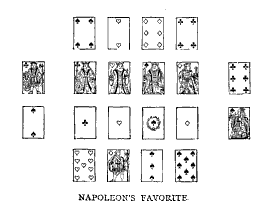
Napoleon's Favorite (Double Deck Solitaire Game)


Two Entire Packs of Cards

Rules

  1. After the first deal has been completed, the uppermost card of each packet is available, subject, however, to the following restrictions:


    • That card on each of the four packets immediately above the kings can only be employed to build up the families on the king foundations.
    • That card on each of the four packets immediately below the aces can only be used to build up the ace foundations. The uppermost card on each of the packets which are right and left of the foundation cards, may be played on any of the foundations without restriction.
    • The removal of the uppermost card from any packet releases the one beneath it.
    • After either re-deal is completed, all the uppermost cards of the twelve packets are available without any restrictions.
  2. The foundations must follow suit.
  3. Marriages may be formed in ascending or descending sequence, and need not follow suit.
Play

Withdraw from the pack and place the four aces and four kings as in the pattern tableau. These are the foundation cards. The four kings in the upper row begin with queens and descend in sequence to aces; the aces in the lower row begin with deuces and ascend in sequence to kings. 

Next shuffle the two packs, and deal four cards in a horizontal row above the kings, beginning at the left and dealing to the right; then deal one card at the right of the king row, and one at the right of the ace row.

Continue dealing four more cards under the ace row, beginning at the right and dealing to the left, and conclude by dealing one card each at the left end of the ace and king rows. Having dealt this first round, proceed to deal successive rounds, each covering the preceding one, until all the cards are exhausted.

After the deal has been completed, examine all the twelve packets and play all suitable cards upon the foundations subject to Rule 1. When all suitable cards have been played, proceed to form marriages upon any of the twelve packets. The sequences of the marriages may be transferred from packet to packet, provided Rule 3 is not infringed. 

Great judgment must be observed in forming the marriages, for it is by this means that suitable cards are released for the foundations. It is not good play to exhaust a packet entirely, when this can be avoided, for the more packets that remain, the more facilities are afforded for forming marriages. 

Two re-deals are permitted. 

 (From Dick's games of patience: or, Solitaire with cards, by William Brisbane Dick [1884].)